Driveway Paving in Hudson & West Central Florida
New asphalt driveways, resurfacing, widening, millings, and repair. Measured on site, quoted in writing, installed by a family paving business operating since 1960.
Your Driveway Is Not a Small Parking Lot
Residential driveways fail for different reasons than commercial pavement. They carry light loads but sit in full sun, they meet a garage slab at one end and a county road at the other, and they usually have to shed water without any storm drain to send it to. Sandy subgrade, a high water table, and heavy summer rain make the base and the drainage path matter more than raw thickness.
We measure the driveway, check what is under the existing surface, look at where water goes during a storm, and confirm how equipment can reach the work. Then we recommend new construction, resurfacing, milling, or millings, and put the reasoning in the quote alongside the price. If a cheaper option will hold up on your property, we will say so.
Documented Driveway and Surface Work
Real projects with the actual location, completion date, scope, and original photographs. No stock imagery and no borrowed case studies.

Community Basketball Court Resurfacing
Basketball court resurfacing and restriping at a community recreation facility in Hudson. Photos show a blue acrylic surface, yellow boundary markings, white game lines, and multiple hoops.

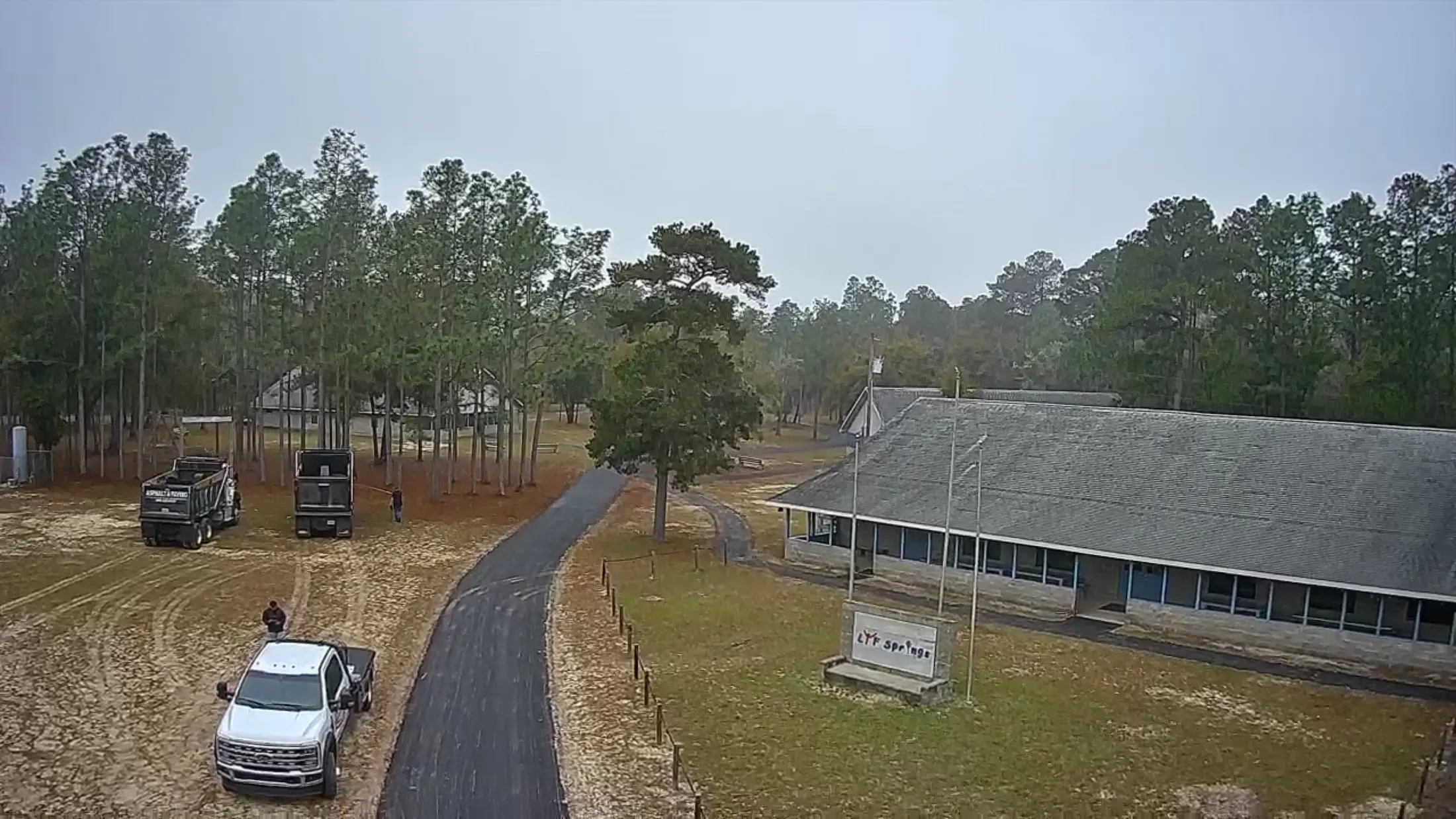
Floral City Asphalt Driveway & Walkway
New paved asphalt residential driveway and walkway area in Floral City. The recorded scope included added base material and a vegetation-control spray treatment. Previous existing driveway was old asphalt recycled millings and gravel. Elderly couple needed a smooth walkway and driveway for easier mobility and accessibility.

New Port Richey Driveway Extension & Site Preparation
Residential driveway extension and site preparation in New Port Richey. The recorded scope included palm-tree removal, water-line capping, recycled asphalt millings, and a vegetation-control spray treatment. Photos show the finished curved driveway and its connection to the existing access and parking areas.

Community Tennis Court Complex
Tennis-court resurfacing for a multi-court community facility listed in Spring Hill. The recorded scope included an acrylic coating system and new court striping. Photos show multiple courts, lighting poles, nets, and spectator benches.
Four Ways to Approach a Driveway
The right one depends on what the base is doing, not on which costs the most.
New Asphalt Driveway
Full construction where no pavement exists, or where the old driveway and its base both have to come out.
- Excavation and removal of unsuitable material
- Base placed and compacted to support the expected loads
- Grade set to move water away from the garage and house
- Hot mix asphalt placed and rolled in defined lifts
- Edges, garage transition, and road connection finished
Best when: There is no driveway, or the base underneath has failed
Resurfacing / Overlay
New asphalt placed over a driveway whose base is still sound, restoring the surface without a full rebuild.
- Existing surface cleaned and failed areas repaired first
- Elevations checked at the garage, sidewalk, and road
- Adds height, so transitions have to be confirmed beforehand
- Faster and less costly than full replacement
- Not appropriate over a base that moves or holds water
Best when: The surface is worn but the base is still stable
Mill and Pave
The old surface is ground off and hauled away, then new asphalt is placed back at the original elevation.
- Keeps existing heights at the garage and road connection
- Removes surface material that has oxidized or deformed
- Lets the base be inspected and repaired where needed
- Milled material can be recycled into millings work
- The right call when an overlay would raise grades too far
Best when: Elevations leave no room to add material on top
Millings Driveway
Recycled asphalt spread and compacted in place. A practical surface for long rural approaches and property extensions.
- Costs meaningfully less than hot mix asphalt
- Well suited to long driveways and acreage properties
- Compacts and firms up with traffic, sun, and time
- Can be topped with asphalt later as budget allows
- Finish is not as smooth or uniform as new asphalt
Best when: A long approach needs a firm surface on a working budget
What Actually Drives Driveway Cost
Anyone quoting a per-square-foot price over the phone has not seen your base, your grade, or your access.
Measured Square Footage
Length and width measured on site, including any turnaround, apron, or parking pad. Estimated dimensions are where quotes drift.
Condition of the Base
A sound base needs preparation. A failed base needs excavation, replacement material, and compaction, which changes the project substantially.
Grade and Drainage
If water currently sits on the driveway or runs toward the garage, correcting the grade becomes part of the work rather than an afterthought.
Removal and Disposal
Existing asphalt or concrete has to be broken out, loaded, and hauled. Thicker or reinforced material takes more time and more trucking.
Access for Equipment
Narrow gates, low limbs, tight turns, and soft ground change which equipment can be used and how long placement takes.
Compacted Thickness
Specified thickness reflects expected vehicles and base condition. It is a scope decision that should appear in writing on every quote.
Comparing quotes fairly
Two driveway quotes are only comparable when both list compacted thickness, what happens to the existing surface, how the base is prepared, and what is done at the garage, sidewalk, and road connection. A lower number that omits base work is not a better price, it is a smaller job. Ask every bidder to put those four items in writing.
How a Driveway Project Runs
Site visit and measurement
We measure the driveway, probe the existing surface and base, look at where water travels during rain, and confirm how equipment will reach the work.
Written scope and quote
You receive a written quote listing preparation, materials, compacted thickness, drainage work, and finish details, so it can be compared against any other bid line by line.
Scheduling around weather
Asphalt placement depends on dry conditions and temperature. We discuss availability, access, and rain contingencies before committing to a date.
Removal and base preparation
Existing material is removed where required, unsuitable soil is addressed, base material is placed, and grade is set for drainage before any asphalt arrives.
Placement and compaction
Hot mix is placed and rolled in defined lifts by our own crew using our own pavers and rollers, which keeps quality control in house.
Edges and transitions
Garage entry, sidewalk crossing, road connection, and driveway edges are finished so the surface sheds water and holds up where it meets other surfaces.
Walkthrough and cure guidance
We walk the finished driveway with you and give opening and cure guidance specific to the mix, thickness, weather, and shade on your property.
West Central Florida conditions
Why Florida Driveways Age the Way They Do
The two things that end most driveways here are ultraviolet oxidation and water in the base. Sun bakes the binder until the surface turns gray and starts shedding aggregate. Water that cannot leave the base softens the support underneath, and the pavement above it cracks and sinks in patches rather than uniformly.
Neither is fixed by adding thickness alone. Positive drainage, sound edges, and a maintained surface do more for driveway life in this climate than an extra half inch of asphalt over a base that holds water.
Hudson properties generally fall in unincorporated Pasco County. Work that changes a driveway connection to a county road, adds fill, or alters where runoff goes may require review by the responsible agency, and we identify that during the site visit.
Repair or Replace?
Repair is usually enough when
- Cracks are narrow, isolated, and not connected in a pattern
- A single low spot or pothole with sound pavement around it
- The surface is gray and dry but still firm underfoot
- Damage is limited to one area, such as the road apron
- The base shows no movement when loaded
Replacement is the honest answer when
- Interconnected cracking across a large share of the surface
- Areas that flex, sink, or feel soft when a vehicle sits on them
- Water repeatedly stands on the driveway after rain
- Repeated patching has stopped holding
- The base has washed out or was never adequate for the loads
Driveway Paving Service Areas
Residential driveway work across Pasco, Hernando, and Pinellas counties
Driveway Paving Questions
How much does an asphalt driveway cost in Florida?
Driveway pricing depends on measured square footage, the condition of the existing surface and base, how much excavation or fill the grade requires, access for equipment, the compacted thickness specified, and whether drainage work is needed. A short flat driveway over sound base and a long driveway needing base repair and regrading are very different projects. We measure the driveway on site and provide a written quote that lists preparation, materials, thickness, and finish work so the number can be compared line by line.
Is asphalt or concrete better for a Florida driveway?
Both perform well in Florida when installed correctly. Asphalt costs less per square foot, installs faster, tolerates minor ground movement without cracking as visibly, and can be resurfaced later rather than replaced. Concrete lasts longer before major work and stays lighter in color. Asphalt does need periodic sealcoating to resist UV oxidation. The right choice depends on budget, how long you plan to keep the property, and how the driveway drains.
Can you resurface my driveway instead of replacing it?
Often, yes. Resurfacing places new asphalt over the existing driveway and works well when the base is still stable, the surface is not badly deformed, and added height will not create problems at the garage, sidewalk, or road connection. Where the base has failed, where the driveway holds water, or where elevations leave no room for new material, milling or full replacement is the more durable answer. We evaluate the base before recommending either.
What is a millings driveway and is it a good option?
A millings driveway uses recycled asphalt, ground from previous paving work, spread and compacted in place. It costs less than hot mix asphalt, suits long rural driveways and property extensions, and firms up over time as traffic and sun compact it. It will not give the smooth uniform finish of new asphalt and it can shed loose material at the edges. For many Pasco, Hernando, and Citrus county properties with long approaches, millings are a practical middle ground between dirt and full pavement.
How long before I can park on a new asphalt driveway?
The crew gives opening guidance for your specific driveway based on the mix, lift thickness, weather, and shade. New asphalt stays soft longer in Florida heat and remains vulnerable to scuffing and indentation at first. Avoid sharp stationary turns, kickstands, jack stands, and trailer tongues resting in one spot until the surface has cured and firmed.
When should a new asphalt driveway be sealcoated?
New asphalt needs time to cure before its first sealcoat, and applying it too early can trap oils and soften the surface. We give a project-specific window rather than a fixed date, because cure time depends on mix, thickness, sun exposure, and season. After the first application, resealing on a regular cycle slows UV oxidation, which is the main cause of Florida driveways graying and raveling.
Get a Measured Driveway Quote
We measure on site, check the base and drainage, and put preparation, thickness, and finish work in writing before you decide.
Free project estimates • Family paving heritage since 1960