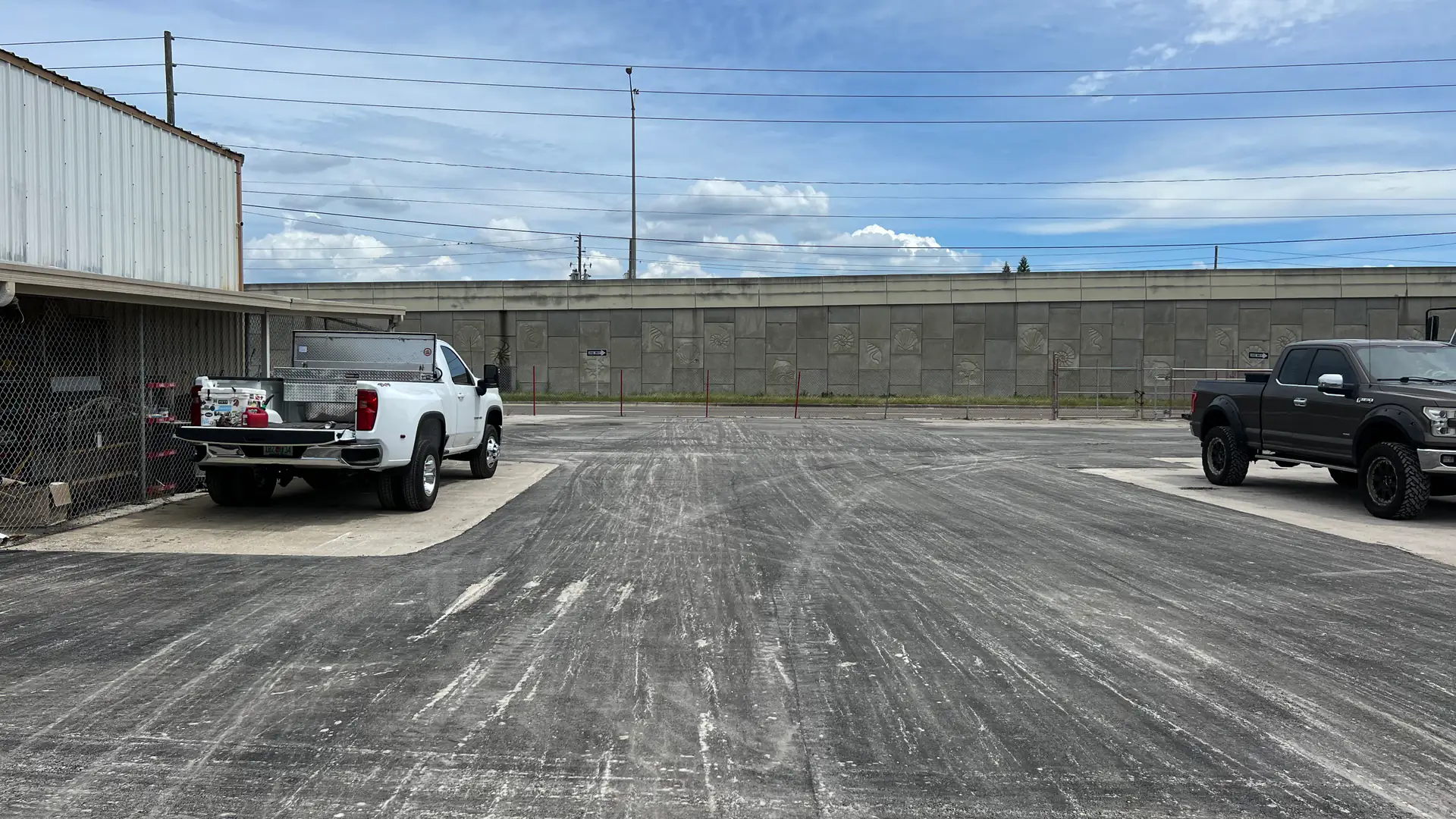
Professional Asphalt Milling Services
Controlled removal of existing asphalt for overlay preparation, elevation transitions, localized profile corrections, and access to failed areas. Milling depth and suitability depend on pavement structure, grades, utilities, drainage, and the planned replacement section.
Reclaimed asphalt is loaded and handled as defined in the proposal; destination, acceptance, hauling, and any material value vary by project.
Asphalt Milling in Hudson, FL
Milling, also called cold planing, removes a controlled portion of existing asphalt. It can prepare a textured surface for an overlay, lower pavement at curbs and structures, remove deteriorated layers, or help establish a planned profile.
Milling is not automatically a replacement for excavation or full-depth repair. The available pavement thickness, base condition, buried utilities, structures, slopes, and final lift determine what can be removed and whether additional repairs are needed.
Reclaimed asphalt pavement can often be accepted for processing or reuse, but the receiving facility, contamination, ownership, trucking, and project specifications govern material handling. The proposal should state whether material is hauled away, stockpiled, reused, or delivered to an approved facility.
When Milling is the Right Solution
✅ Surface Deterioration
Surface oxidation, raveling, or deterioration may be addressed with milling and an overlay when the remaining pavement and base can support the proposed section.
Evaluate: distress depth, remaining structure, elevations, and overlay design
✅ Drainage Corrections
Milling can lower selected high areas or transitions, but drainage correction requires verified elevations, a workable outlet, and enough remaining pavement structure.
Evaluate: survey data, outlet, structures, tie-ins, and final asphalt lift
✅ Height Restrictions
Maintain clearances at garage entrances, loading docks, sidewalk transitions. Remove old layers before adding new.
Evaluate: thresholds, curbs, ramps, utilities, and planned surface elevation
✅ Rutting/Depressions
Profile milling may help address surface irregularities before an overlay, but depressions caused by base failure require repair below the surface.
Evaluate: rut depth, cause, truck loading, base, and remaining pavement
⚠️ Reflective Crack Prevention
Removing a cracked surface layer may reduce some defects, but cracks or movement below the milling depth can reflect through a new overlay.
Important for: Cracked pavements
❌ Not Suitable For
Base failure, alligator cracking, structural issues. These require full-depth reconstruction, not surface milling.
Alternative: Investigate patching, base repair, or reconstruction
Milling Approaches & Applications
Surface Milling
Removes part of the existing surface where the remaining pavement, elevations, and planned treatment support a shallow cut.
Standard Milling
Removes the planned surface course for an overlay, transition, or profile correction. It does not eliminate distress below the cut.
Deep Milling
Deeper cuts may expose lower asphalt lifts, base, utilities, structures, or prior repairs and can change the required equipment and hauling plan.
Handling Reclaimed Asphalt Pavement
Define Ownership
The proposal states who retains the material and where it will be hauled or stockpiled.
Confirm Acceptance
Receiving options depend on contamination, material condition, facility rules, and project specifications.
Price the Logistics
Loading, trucking, disposal or processing fees, stockpile access, and haul distance affect the estimate.
Our Milling Process
Site Survey & Depth Verification
Review available plans, pavement condition, structures, utilities, drainage, and final elevations. Cores or survey data may be recommended when existing thickness or grades cannot be confirmed from records and field observations.
Machine Calibration & Setup
Select equipment, cutting setup, trucks, traffic control, and dust-control measures for the required depth, access, surface, haul plan, and project specifications.
Controlled Milling Operation
Remove the planned pavement in passes suited to site geometry and existing conditions. Monitor the cut near edges, utilities, structures, weak areas, and transitions, and load reclaimed material according to the haul plan.
Edge Cleanup & Transitions
Use appropriately sized equipment and hand work around edges, utility structures, curbs, and restricted areas. Sweep and inspect the milled surface before the next construction step.
Surface Preparation & Documentation
Identify loose material, exposed failures, grade issues, and repairs required before paving. Apply tack coat and other preparation as specified, and document material quantities or closeout items included in the contract.
Production Factors
Depth, machine access, passes, trucks, edges, traffic control, and weather
Grade Control
Method depends on the equipment, existing surface, survey information, and project tolerance
Material Handling
Loading, ownership, destination, acceptance, haul distance, and fees defined per project
Milling Estimate & Suitability Factors
Quantity & Depth
Area, number of passes, planned cut, edges, and isolated deeper sections
Site Access
Machine access, structures, traffic control, phasing, truck staging, and work hours
Material Handling
Loading, trucking, destination, acceptance, stockpiling, processing, and fees
Follow-On Work
Base repairs, sweeping, tack, transitions, asphalt replacement, striping, and inspections
Milling and full-depth removal address different conditions. A field evaluation is needed before comparing scopes or pricing.
Private Road Milling Services
Private-road work requires clear ownership, access rights, project limits, traffic planning, drainage review, and agreement among responsible parties. Milling may be part of an overlay or repair plan when the remaining pavement and base are suitable.
Private Road Milling Applications
- Shared driveways with multiple property owners
- Rural subdivision entrance roads
- Ranch and farm access roads
- HOA-maintained private streets
- Private marina and RV park access roads
Private-Road Planning Considerations
- Shared scope: Define ownership, limits, approvals, and cost allocation before award
- Drainage: Verify elevations and an outlet before using milling for profile changes
- Access: Establish vehicle, delivery, and emergency-access plans for each phase
- Material handling: Define who retains reclaimed asphalt and where it will go
Before Requesting a Shared-Road Proposal
Asphalt Milling FAQs
Is milling less expensive than complete removal?
It can be, but the methods are not interchangeable. Milling removes asphalt at a controlled depth; excavation may be needed for failed base, unsuitable material, or deeper reconstruction. Compare written scopes that include removal depth, repairs, trucking, material handling, replacement asphalt, traffic control, and finish work.
Can milling fix drainage problems?
Sometimes. Milling can lower selected high areas or transitions, but a drainage correction requires reliable elevations, a workable outlet, enough pavement structure below the cut, and a replacement surface that achieves the planned profile. Base settlement or a poor outlet may require a different repair.
Is the milled surface ready for immediate paving?
Not automatically. The surface must be swept and inspected for loose material, exposed failures, moisture, grade issues, and repairs. Tack coat and any additional preparation follow the asphalt specification and actual field conditions. Scheduling depends on weather, repairs, material supply, and access.
How disruptive is milling to business operations?
Disruption depends on the area, depth, access, truck route, structures, traffic control, and paving sequence. A milled surface may contain abrupt edges, loose material, exposed structures, or grade changes and should not be opened unless the project team has determined it is suitable and marked the route.
What happens to the milled asphalt material?
Reclaimed asphalt is loaded, hauled, stockpiled, reused, processed, or disposed of as stated in the proposal. Receiving options depend on ownership, contamination, facility acceptance, haul distance, project specifications, and applicable fees. Any credit must be documented for that project rather than assumed.
When is milling not appropriate?
Milling may be unsuitable where the remaining pavement cannot support the next lift, the base has failed, utilities or structures conflict with the cut, or the required grade cannot be achieved safely. Small or isolated failures may be better addressed with patching, but the decision depends on mobilization, access, depth, and the complete repair scope.
Planning an Asphalt Milling Project?
Request a site review based on pavement condition, milling depth, final grades, access, material handling, and follow-on paving.
Free project estimates • Family paving heritage since 1960